For years, the blender market was a race for raw horsepower, but the conversation has shifted toward intelligence and kitchen integration. I recently spent a fortnight stress-testing two of Vitamix’s newest contenders: the Ascent X2 and the Ascent X3. These aren’t just motors in a box; they are part of a wireless ecosystem designed to recognize what you’re making before you even hit “start.”
While they share the same DNA—a relentless 2.2 HP motor and a 10-year safety net of a warranty—the experience of using them side-by-side reveals a fork in the road for design and user interaction. One feels like a dependable, modernized classic, while the other leans into a futuristic, touch-first philosophy. I’ve pulverized everything from stubborn kale stems to frozen pits to see which one actually earns its keep on a crowded countertop.
The Key Difference: Control Interface and Design Language
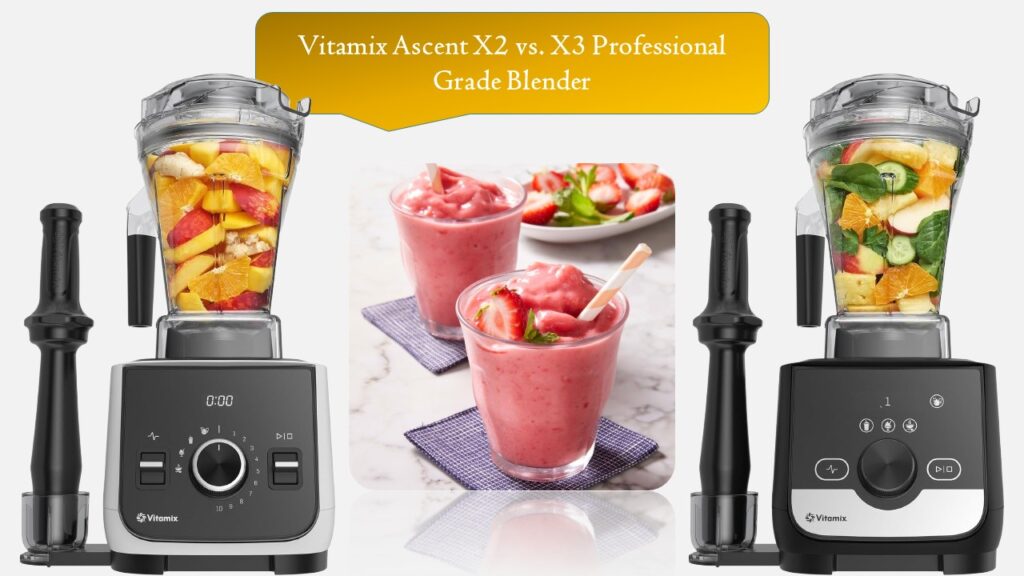
The fundamental key difference between the Vitamix Ascent X2 and the X3 is the evolution of the user interface and the aesthetic finish. The Ascent X2 acts as the bridge between legacy blenders and the smart era, utilizing a digital timer paired with more traditional, tactile controls. It is often showcased in a “Polar White” finish, emphasizing a bright, accessible look for the home cook who appreciates a physical connection to their appliances.
The Ascent X3 represents the “tech-forward” evolution, moving toward a seamless touch-button control panel. While it offers the same three core programs (Smoothies, Hot Soups, and Frozen Desserts), the X3 prioritizes a “Shadow Black” aesthetic and a flat-panel design that eliminates crevices. While the blending results are identical, the X3 provides a more premium, smartphone-like interaction that appeals to the modern minimalist.
Comparison Table: Vitamix Ascent X2 vs. Ascent X3
| Feature | Vitamix Ascent X2 | Vitamix Ascent X3 |
| Interface Technology | Digital Timer + Tactile Feel | Integrated Touch Controls |
| Color Profile | Polar White | Shadow Black |
| Included Programs | 3 (Smoothie, Soup, Dessert) | 3 (Smoothie, Soup, Dessert) |
| Self-Cleaning Mode | Yes (60 Seconds) | Yes (60 Seconds) |
| Motor Strength | 2.2 Peak HP | 2.2 Peak HP |
| Height profile | 17 Inches | 17 Inches |
| Container Geometry | 48 oz Low-Profile | 48 oz Low-Profile |
| Smart Sensing | SELF-DETECT® Technology | SELF-DETECT® Technology |
| Warranty | 10-Year Full Coverage | 10-Year Full Warranty |
| View Current Price | View on Amazon | View on Amazon |
Detailed Comparative Review: My Personal Experience
When you spend enough time with high-end blenders, you stop looking at the motor and start looking at the workflow. I lived with the X2 and X3 to see how they handled the chaos of a Monday morning and the precision of a Friday night dinner party.
Design: The Battle of White and Black
The Ascent X2 in Polar White is a breath of fresh air. In a world of black and stainless appliances, it pops. Because it stands at 17 inches, I could keep it fully assembled under my cabinets. The design is inviting; it feels like a friendly kitchen companion rather than a daunting piece of machinery.
The Ascent X3 in Shadow Black is the opposite—it’s “stealth wealth” for your kitchen. It’s sleek, dark, and disappears into the background until you wake up the digital display. If you have a dark backsplash or a modern industrial kitchen, the X3 is the aesthetic winner. However, I did notice that the glossy black panel shows flour dust and water spots more quickly than the white X2.
Ease of Use: Buttons vs. Glass
This is where the models truly diverge.
- On the X2, the buttons have a distinct “give.” When I’m in a rush and my hands are a little slippery, there’s no guessing if I’ve pressed the button or not. It’s a reliable, old-school feel that hasn’t been completely phased out.
- On the X3, the touch panel is incredibly sensitive and fast. It feels like using a premium tablet. I loved that there are no gaps around the buttons where a spilled smoothie could get stuck. A single swipe with a damp cloth and the X3 looks brand new. If you prefer a seamless, “all-glass” feel to your kitchen, the X3 wins on ergonomics.
Performance: Raw Power and Smart Sensors
Regardless of which model I turned on, the 2.2 HP motor was relentless. I made a batch of peanut butter, which is the ultimate test for any blender. Both the X2 and X3 handled the thick, sticky load without entering thermal protection mode.
The SELF-DETECT® feature on both models is a game-changer for safety. I tried to run the “Soup” program on a small 20-ounce blending cup, and the machine simply wouldn’t do it. It knows that the pressure from a hot blend in a small, sealed container is a hazard. This “digital brain” makes both the X2 and X3 much safer for families than the older, purely mechanical blenders.
Cleanup: The 60-Second Refresh
I am a firm believer that if an appliance is hard to clean, you won’t use it. Both machines have a dedicated self-cleaning program. I added a drop of soap, some warm water, and 60 seconds later, the containers were spotless. The 48-ounce container on both is dishwasher safe, but honestly, the self-clean cycle is so effective I rarely felt the need to take up space in the dishwasher.
Vitamix Ascent X2 Professional Grade Blender
Pros:
- Tactile Feedback: Physical feel to the controls is great for traditionalists.
- Aesthetic Appeal: Polar White finish brightens up dark kitchen corners.
- Cabinet Friendly: Low-profile container fits under 90% of standard cabinets.
- Safety First: Includes the full suite of sensor technology.
Cons:
- Detail Cleaning: More difficult to clean around the button edges.
- Analog Feel: Might feel slightly “dated” to users who love touchscreens.
Vitamix Ascent X3 Professional Grade Blender
Pros:
- Hygiene Factor: The flat touch panel is the easiest surface I’ve ever cleaned on a blender.
- Modern Interface: High-end feel that matches modern kitchen tech.
- Stealth Look: Shadow Black hides minor stains and looks professional.
- Pro-Grade Build: Feels like a piece of equipment used in a high-end smoothie bar.
Cons:
- Visibility: Dust and fingerprints are more obvious on the dark glossy surface.
- Learning Curve: Touch sensitivity might take a few tries to master with wet hands.
The Final Recommendation: Which Ascent Model is Right for You?
I recommend the Vitamix Ascent X2 if you want the perfect balance of modern tech and traditional usability. If you find touchscreens finicky and prefer the “click” of a button, the X2 offers all the smart features (like Bluetooth and SELF-DETECT®) without the learning curve of a glass interface. It’s a beautiful, powerful machine that feels right at home in a family kitchen.

Vitamix Ascent X2 Professional-Grade Blender, 3 Programs, Polar White | 48 oz. Container, Kitchen Appliance for Smoothies, Soups and More,…
- Included: Ascent X2 blender motor base, 48-ounce container, S2 low-profile tamper, tamper holder, and digital recipe book; this kitchen blender container allows for small- to medium-capacity blends
- Three Blending Programs: Three automatic Blending Programs for Smoothies, Frozen Desserts, and Soups ensure consistent results; achieve precise textures with variable speed settings and a Pulse Function
I recommend the Vitamix Ascent X3 if you are a “tech-first” cook who values a seamless design. If you prioritize easy cleanup and want a blender that looks like a futuristic piece of glass on your counter, the X3 is the one. Its Shadow Black finish and touch controls make it the more sophisticated choice for modern homes.
In my personal kitchen, the Ascent X3 is the one I’d keep. The ability to wipe the entire control panel clean in one second flat is a feature that saves me frustration every single morning.

Vitamix Ascent X3 Professional-Grade Blender, 3 Programs, Shadow Black | 48 oz. Container, Kitchen Appliance for Smoothies, Soups and More,…
- Included: Ascent X3 blender motor base, 48-ounce container, S2 low-profile tamper, tamper holder, and digital recipe book; this kitchen blender container allows for small- to medium-capacity blends
- Three Blending Programs: Three automatic Blending Programs for Smoothies, Hot Soups, and Frozen Desserts ensure consistent results; achieve precise textures with variable speed settings and a Pulse Function for ice crushing
Frequently Asked Questions (FAQs)
Q: Do these blenders come with a physical recipe book?
A: They come with a high-quality digital recipe book, and the box includes a “Getting Started” guide to help you master the basic programs immediately.
Q: Is the 48-ounce container big enough for a family of four?
A: It is perfect for 2–4 servings. If you are making massive batches of soup or smoothies for more than four people, you might want to buy the 64-ounce SELF-DETECT® container separately.
Q: Can I use the blades to make flour?
A: Yes. The stainless steel blades are designed to handle “dry grains.” You can turn wheat berries into flour or oats into oat flour in less than a minute.
Q: How loud are these compared to older models?
A: The Ascent series is significantly quieter than the older “Classic” series like the 5200. They have a more refined, dampened sound, though they are still powerful machines that make noise at high speeds.