There is a legendary status attached to the name Vitamix that usually conjures images of professional chefs in high-end restaurant kitchens pulverizing stalks of lemongrass into silk. But when you bring that industrial power into a home kitchen, you’re faced with a choice that feels surprisingly like picking between a vintage manual sports car and a modern electric sedan with a touchscreen.
I’ve spent the last few weeks in a state of perpetual “smoothie-shock,” putting the Vitamix Explorian E310 and the Vitamix Ascent A2300 through a grueling gauntlet of frozen fruit, fibrous kale, and dry-roasted peanuts. One is a stripped-back, analog machine that feels like it was built to survive a century; the other is a sophisticated, “Smart-system” blender that wants to be the brain of your kitchen. After dozens of batches, I’ve found that while they both possess the raw, 2-horsepower muscle needed to liquefy a brick, the way they fit into your daily routine is worlds apart.
The Key Difference: Ecosystem and Intelligence
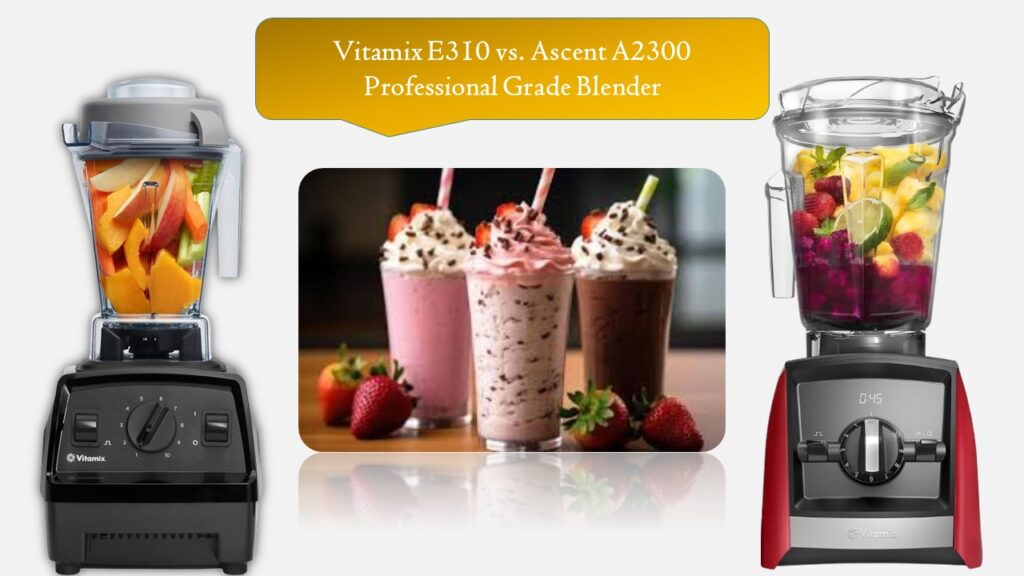
The fundamental difference between the Vitamix E310 and the Ascent A2300 is the technology platform and container compatibility. The Ascent A2300 is a “Smart-System” blender, featuring Self-Detect wireless connectivity that recognizes which container you’re using and adjusts the motor settings accordingly. It also includes a built-in digital timer and a 64-oz low-profile container.
The Explorian E310 is a “Classic” series blender, purely mechanical with no wireless sensors, and it comes with a smaller 48-oz container. While the E310 is a standalone power tool, the A2300 is part of an expandable digital ecosystem that includes a 10-year warranty compared to the E310’s 5-year coverage.
Comparison Table: Vitamix Explorian E310 vs. Ascent A2300
| Feature | Vitamix Explorian E310 | Vitamix Ascent A2300 |
| Series | Explorian (Classic) | Ascent (Smart-System) |
| Container Capacity | 48 oz | 64 oz (Low-Profile) |
| Warranty | 5 Years | 10 Years |
| Wireless Tech | No | Yes (Self-Detect Technology) |
| Digital Timer | No | Yes (Built-in Display) |
| Lid Design | Rubber (Friction Fit) | Clear (Snap-Lock) |
| Motor Power | 2.0 HP | 2.2 HP (Approx.) |
| Dimensions | 11″D x 8″W x 18″H | 11″D x 8″W x 17″H |
| Self-Cleaning | Yes | Yes |
| View Current Price on Amazon | View on Amazon | View on Amazon |
Detailed Comparative Review: My Personal Kitchen Chronicles
To see if “Smart” actually translates to “Better,” I ignored the manuals and treated these machines like the heavy-duty appliances they claim to be.
Design: Industrial Gritty vs. Sleek Sophistication
The first thing I felt when I gripped the dial of the E310 was its honesty. It feels like a tool. The switches are toggle-style, and the base is heavy, textured plastic that doesn’t show fingerprints. However, at 18 inches tall with the 48-oz pitcher attached, it barely didn’t fit under my standard kitchen cabinets. I had to store the base and the pitcher side-by-side.
The A2300 is a different beast entirely. It’s shorter (17 inches) thanks to the Low-Profile 64-oz container, meaning it slid right under my cabinets with room to spare. The design is much more “lifestyle” focused. It has a digital timer that glows when you turn it on, and the clear lid is a massive improvement over the E310’s heavy rubber lid. On the A2300, I can actually see what’s happening from the top down without stopping the motor.
Ease of Use: The Power of the Timer
If you think a timer on a blender is a gimmick, you haven’t lived with the A2300. When I was making a green smoothie—which usually needs a full 60 seconds to truly liquefy the seeds—I didn’t have to stand there watching it. I could see the digital seconds counting up.
The E310 is purely manual. You turn it on, you count in your head, and you turn it off. For simple tasks, this is fine. But for things like nut butter, where you need to blend for exactly 2 minutes to prevent the motor from overheating while achieving the right consistency, the E310 feels a bit more “analog” than I’d like. However, the E310’s 48-oz container is actually better for small batches. I tried making a single-serve vinaigrette in both; the A2300’s wide 64-oz base struggled to catch the ingredients, while the E310’s narrower base pulled them into the vortex instantly.
Functions: Raw Torque and Wireless Brains
Both blenders feature the 10-speed variable dial. At speed 10, they both sound like a Harrier jet taking off in your kitchen—it’s loud, but it’s the sound of results.
The A2300’s Self-Detect technology is the real differentiator here. If I swap the 64-oz jar for one of Vitamix’s 20-oz “Blend-and-Go” cups (sold separately), the A2300 knows. It won’t let the motor run at full blast for a small cup, preventing the lid from blowing off. The E310 doesn’t have this. It will spin anything you put on it with the same raw aggression. If you want a machine that grows with you—if you plan on buying the small bowls or the food processor attachment later—the A2300 is the only choice. The E310 is “what you see is what you get.”
Maintenance: The Clear Winner
Vitamix is famous for being “self-cleaning” (just add soap and water and run on high), but the A2300 is much easier to keep looking new. The low-profile container is wide enough that I can get my whole hand down there with a sponge to reach under the blades. The E310’s container is narrower and taller, making it a bit more of a reach.
Also, the A2300’s lid is dishwasher safe and doesn’t hold onto odors like the E310’s rubber lid does. After making a spicy salsa, the E310 lid smelled like cumin for two days despite a deep soak. The A2300’s hard plastic lid was odorless after one rinse.
Vitamix Explorian E310 Professional Grade Blender
Pros:
- Small Batch Specialist: The narrow 48-oz container is superior for single smoothies or small sauces.
- Mechanical Reliability: Simple switches that are built to last without electronic glitches.
- Price: The most affordable way to own a brand-new, professional-grade Vitamix.
- Compact Base: Takes up less horizontal space on the counter.
Cons:
- Height: At 18 inches, it won’t fit under many standard cabinets.
- Limited Warranty: 5 years is great, but it’s half of what the Ascent series offers.
- Non-Expandable: Does not work with the newer Self-Detect accessories.
Vitamix Ascent A2300 Professional Grade Blender
Pros:
- Digital Ecosystem: Compatible with the full range of Vitamix Self-Detect cups and bowls.
- 10-Year Warranty: An industry-leading commitment to durability.
- Low Profile: Fits under cabinets and has a wider base for easier cleaning.
- Digital Timer: Removes the guesswork for precision recipes.
- Safety: Wireless sensors prevent the machine from starting if the lid isn’t secure.
Cons:
- Small Batch Struggle: The wide base of the 64-oz jar requires more ingredients to create a vortex.
- Price: A significant price jump from the Explorian series.
- Complexity: Some purists may prefer the lack of electronics found in the E310.
The Final Recommendation: Which Vitamix Should You Buy?
After a month of back-to-back blending, the decision comes down to the size of your household and your appetite for gadgets.
I recommend the Vitamix Explorian E310 if you are cooking for one or two people and you want the “pure” Vitamix experience. If you mostly make single smoothies or small batches of pesto and you don’t care about wireless connectivity, the E310 is a power-packed bargain. It is a no-nonsense machine that does exactly what it says on the box.
- Included: Explorian E310 Professional Blender motor base, 48-ounce container, and mini tamper; this kitchen blender container allows for small- to...
I recommend the Vitamix Ascent A2300 if you are a family or a “power user.” The 64-oz capacity is essential for large batches of soup or margaritas, and the 10-year warranty makes the higher price tag much easier to swallow. If you think you might ever want to use the smaller blending cups or the food processor attachment, the A2300 is the only way to go. It’s an investment in a system, not just a blender.

- You're in Control: Variable Speed Control and Pulse feature let you manually fine-tune the texture of any recipe
Personally, I would choose the Vitamix A2300. The digital timer and the fact that it fits under my cabinets make it much more “livable” for a daily user like me.
Frequently Asked Questions (FAQs)
Q: Is the A2300 more powerful than the E310?
A: Technically, yes. The A2300 has a slightly higher peak horsepower (approx 2.2 vs 2.0). In practice, however, they both pulverize everything. You won’t notice a difference in the smoothness of your kale juice between the two.
Q: Can I use the 64-oz jar on the E310 base?
A: You can use “Classic” series 64-oz jars (the tall ones), but the E310 will not recognize the “Self-Detect” low-profile jars used by the Ascent series. Generally, it’s best to stick to the containers designed for your specific series.
Q: Do they both make hot soup?
A: Yes! Both blenders can bring cold ingredients to steaming hot temperatures in about 6 minutes of blending on high speed, purely through the friction of the blades.
Q: Is the digital timer a countdown or a count-up?
A: On the A2300, it is a count-up timer. It shows you exactly how long you’ve been blending, which is great for following recipes that specify “blend for 45 seconds.”
Q: Are Vitamix blenders worth the noise?
A: They are loud—there’s no getting around it. But because they are so powerful, you only have to listen to them for 45-60 seconds to get a perfect result, whereas a cheap blender might struggle for 3 minutes and still leave chunks.